Background
I have many passions in life: drinking coffee, listening to music, and anything that includes walking, be it up a mountain, down a mountain, or side to side (along a beach). But one of my main passions and hobbies, which I don’t talk about much in this blog, is playing rugby. It’s a sport I’ve played for roughly 25 years and something I genuinely love.
I started at the age of about 5 or 6, having joined my older brother’s touch rugby team. My dad helped coach them every Sunday, and it gave my mum some well-earned rest from two of her three squabbling sons. Being a fiercely competitive and impatient child, and after realising the older boys I was alongside were faster and stronger than me, I had a tantrum and quit. It wasn’t until the age of 8 that I started playing again. The PE teacher at my new school was a good rugby coach, and soon helped me reignite my rugby flame. I also rejoined the club where I’d played with my brother. This time, with boys my age. I played through the age groups at this club up until 18 and represented my county on various occasions as a teenager. I was good but never amazing. I had passion and grit, but not the wow factor. I continue to play now to this day in my 30’s.
I never planned on taking it any further in rugby, even as a child. ‘Going pro’ was never something I wanted, and I soon learned that to be a level above everyone else in sport, hours and hours of dedication and hard work were required. It would mean giving up other passions and hobbies I had. As a teenager, this mostly consisted of playing video games and plucking up the courage to speak to girls I liked. I also never planned on having bipolar. Unfortunately, this became a reality following my diagnosis at the age of 21. By this point, I was thriving in my university rugby team. I was very active and physically fit. Suffering an acute mental health crisis and playing sports don’t mix. I put rugby on the back-burner while I recovered from a psychotic episode in late 2014. It’s been ten years since I received my diagnosis. Being on long-term medication, including occasional sleeping tablets (and anxiolytics), as well as receiving psychological therapy, I’ve managed pretty well. Not to mention my network of family and friends who’ve supported me over the years.
Family tries
In more recent times, I’ve rekindled that rugby flame, which has been rooted deep within my family for generations. Ten years ago, my paternal grandfather passed away. Back in the 40s and 50s, he played fly-half, representing teams such as Warrington, Birkenhead Park and the counties of Cheshire and Lancashire. During national service, he played for the RAF. He had a strong sense of duty, and coupled with a love of rugby, he helped motivate me when I needed it most. When I was 14, I was picked to represent Cheshire after several weeks of strenuous trials and assessments. We were up against our neighbours, Lancashire, but due to an injury in the under-14’s first team, I was called up to start at fullback. This petrified me. I had a real sense of imposter syndrome, with absolutely no confidence in my abilities; I simply didn’t think I was good enough. When my dad gave me the news on selection, my heart started racing, I felt sick, and was overcome with anxiety. I point blank refused to play. An hour or so later, my dad passed me the landline.
This is my best memory of the conversation that followed:
“It’s Grandpa, he wants to speak to you”.
I trembled as I put the phone to my ear.
“He…Hello?”
“Jamie. Your father tells me you don’t want to play for Cheshire next week. What’s this all about?”
“I..I just don’t want to, and I don’t think I’m good enough to play for the first team.”
“You are good enough. You’ve been picked, and you will play. You’re a Plumb, and you have a responsibility to honour the coaches, and the team, who are expecting you to play. It’s your duty.”
Duty. This hit me like a tonne of bricks. After I put down the phone, I took out my frustrations on my dad, and spent the rest of the evening deliberating. I felt so conflicted.
I eventually made my decision: I was going to play for Cheshire. The following week, my grandparents drove me to the match. I played well and felt pride in stepping up to a seemingly impossible challenge. I was also relieved that I was able to represent my county and play in front of my grandparents, who knew how much of an honour this opportunity was. Unfortunately, my sports performance anxiety wasn’t fully quelled after this. As much as I loved rugby growing up, it was a frequent hindrance on my mental wellbeing and became a source of angst every time I played at a relatively high level.

Winging it
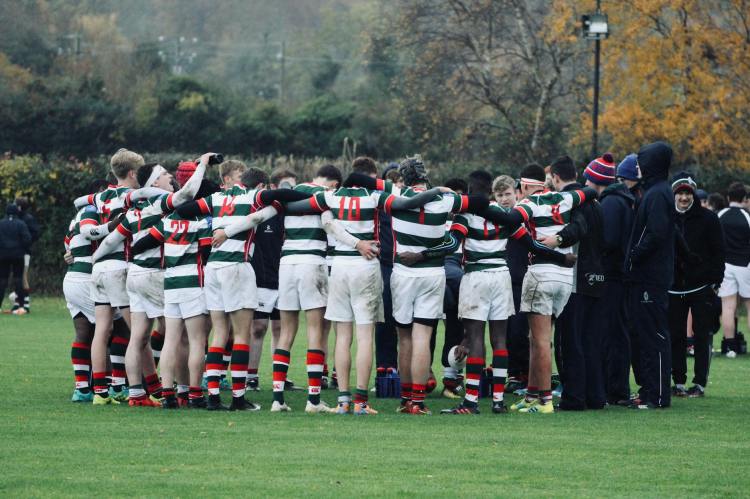
As a doctor, I now find rugby to be a huge stress relief, rather than a source of strain and pressure. After work, training allows me to decompress, open that mental valve, and channel my energy into something physical and healthy. It’s also a great opportunity to catch up with your mates who you share the field with. After a long week, playing an eighty minute match with a group who share your passion for the sport is a genuine pleasure. It’s something to be celebrated. I no longer spend my nights worrying about missing a tackle or dropping a high ball. Whenever I get picked to play for my local team, although I still feel some nerves, I soon overcome them with feelings of excitement and pride. Getting older in the sport does mean I need to be more mindful of sustaining injuries. As a side note, It goes without saying that rugby can be incredibly dangerous, and people do get hurt. My body needs longer to recover, and I need to respect that. However, over the years rugby has allowed me to appreciate the beauty of playing within a community. A community that’s inclusive, supportive, and incredibly fun to be a part of. My current club is over 150 years old, making it one of the oldest in the world! It remains to be an amateur club, much like the one where I played growing up.
In touch
As I mentioned earlier, rugby consistently benefits my mental wellbeing. It’s a great source of exercise, allowing me to burn off pent up energy and frustrations from my job. When I feel good about myself, I tend to play better; I find it easier to concentrate and focus on the match. Sleep has a significant effect on my mental wellbeing, and therefore can affect the way I play. A good night’s sleep tends to have a positive effect on my performance, whereas a bad night’s sleep can set me up for a bad game. Conversely, vigorous exercise can have opposing effects on me, depending on the time of day it’s undertaken. An evening workout, if too vigorous, can overstimulate me and keep me awake, whereas the same workout in the morning benefits my sleep. Fluctuations in mood play a huge role in my energy levels; when my mood dips too low, I feel unmotivated and lethargic. I lack adequate energy levels to put my best into the sport. On the other hand, when my mood creeps up a bit too high, I get surges of energy and enthusiasm. Unsurprisingly this helps when I play rugby. Managing these borderline pathological fluctuations in mood isn’t easy, but either way exercise plays a huge role in keeping my mental health in check. Regardless of how I’m feeling, playing a sport where camaraderie and community are core values, I know it’ll benefit me in the long term.
As I write this now in the off season, I’ve noticed that if I lapse in exercising for a week or so, my mood dips and I feel more groggy and lethargic. It’s only when I then go to the gym, or go out on a run, do I then notice the difference. I look forward to the forthcoming season, including the Summer preparations, as I know that with plenty of exercise and social interactions, I can keep my mental health in check.
Rugby isn’t just a sport, it’s a game deeply rooted within many communities with incredibly passionate individuals working together for its betterment. The club I play at, like many grassroots clubs, has an open door policy and welcomes all ages and abilities. As a result of this inclusivity, I’ve comfortably felt at home ever since joining. Rugby is good for me, both mentally and physically and I aim to continue playing until I’m simply too old to carry on. Although my mood can go up and down, as a high ball does, I always feel grounded on a rugby pitch. It’s one of my happy places and a sport I hope to pass on to future generations.


 The Manic Medic
Leave a comment